World of Peppa Pig NETFLIX
- 4.2
- Rating
- 1.00M
- Installs
- Free
- Price
 Analysis by App-foxy
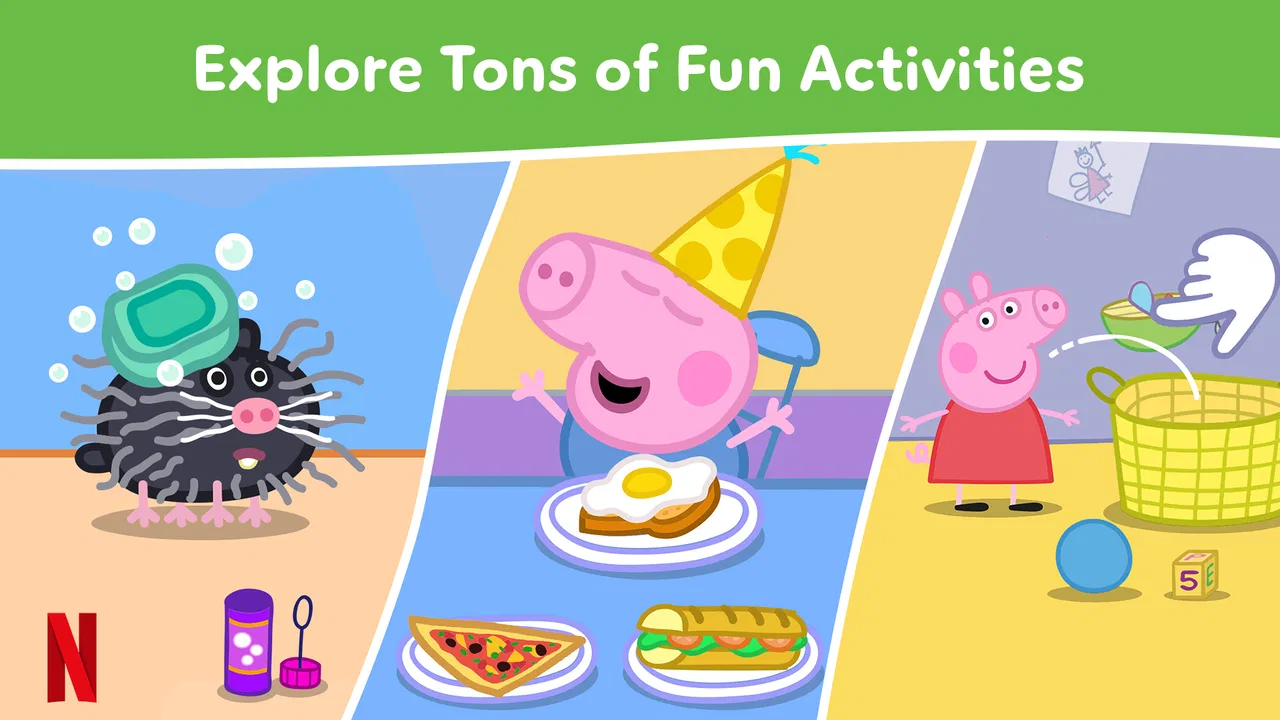
World of Peppa Pig NETFLIX is the kind of educational game I can imagine handing to a young child when the goal is gentle play rather than a demanding challenge. It combines simple puzzles and coloring activities with the familiar Peppa Pig setting, and that combination gives it an immediately approachable feel. I tested it with the mindset of a parent choosing something for short, supervised play sessions, and my first impression was clear: this is designed to feel friendly, recognizable, and easy to enter.
It is a free game from Netflix, Inc., aimed at children and toddlers. The age rating is Everyone, and it belongs to the educational side of mobile gaming rather than action, competition, or open-ended adventure. That distinction matters. I would not choose it for a child looking for complex rules or a long progression system. I would choose it for a child who enjoys Peppa Pig and is ready to practice basic visual attention, matching, and creative interaction through activities that do not feel like schoolwork.
A gentle first impression built around familiarity
The strongest part of the opening experience is how little explanation seems necessary. Peppa Pig already carries a visual language that many children understand: rounded characters, bright colors, expressive faces, and settings that feel safe rather than mysterious. The game uses that familiarity as a bridge into its activities. Instead of asking a young player to learn an unfamiliar world and a complicated interface at the same time, it presents recognizable characters and lets the play feel immediate.
You May Also Like

 Blood Strike: 2.5 Anniversary
Blood Strike’s Loadouts Turn Every Drop Into a Tactical Gamble
A close look at Blood Strike’s custom loadouts: how fast access to signature weapons reshapes its battle royale rhythm, rewards preparation, and narrows the gap between fights.

 Pandora - Music & Podcasts
Pandora’s Music Is Easy to Start, but Harder to Recover
Pandora’s strength is its low-effort path from a seed to a station. Its weak spot is how much confidence it asks you to place in connection, setup, and quiet recovery.

 8 Ball Pool
 Is Built on Rivalries, Rematches, and Routine
A close look at the rivalries, rematches, shared routines, and unanswered safety questions that turn a quick pool match into a persistent mobile community.

 Samsung Music
’s Quiet Strength Is Playing What You Already Own
Its reach comes less from spectacle than from dependable access to a personal library. That simplicity is both the app’s strongest retention engine and its ceiling.

 AccuWeather: Weather Radar
AccuWeather Review: A Quick, Clear Forecast for Everyday Decisions
For everyday plans, the best forecast is the one you can understand quickly. AccuWeather makes rain timing, radar, and local conditions easy to act on, with a few trade-offs.

 Hill Climb Racing
Why Hill Climb Racing Still Turns Crashes Into One More Run
A tiny car, a bumpy hill and one more upgrade: Hill Climb Racing keeps resurfacing because its simple chaos makes every near-miss feel personal.
More From Our News Desk



That simplicity is useful, but it also sets the limits of the experience. The game is not trying to impress older players with elaborate systems. Its value comes from reducing friction. A child can focus on the picture, the puzzle, or the coloring task instead of trying to remember several buttons or interpret a dense menu. In my experience, that makes it better suited to a tablet or a shared family phone than to a player who wants a deep standalone game.
The visual presentation also helps establish the mood before the mechanics have done much work. The art direction favors cheerful shapes and clear objects, which makes the screen easier for small children to read. There is a useful relationship between the way the world looks and the way the activities work: both are uncomplicated, colorful, and reassuring. That coherence is more important here than visual detail. A busier art style might look impressive, but it could make the puzzles and coloring less comfortable for young eyes.
I would still recommend that an adult try the opening session first. This is not because the game feels difficult, but because every child has a different tolerance for prompts, repetition, and touch controls. A quick test lets you see whether the screen size is comfortable and whether the child understands what to do without constant help. For a toddler, that small preparation can make the difference between independent play and frustration.
Who will get the most from it
The natural audience is a young Peppa Pig fan who enjoys tapping, dragging, recognizing pictures, and filling in colors. It can work particularly well for a child who is beginning to use a touchscreen with purpose rather than simply pressing everything on the display. The activities offer a soft introduction to following visual instructions, noticing differences, and completing a small task from beginning to end.
I see less value for children who have already moved on to reading-heavy educational games or more demanding puzzle apps. The game’s appeal depends on its accessible presentation, so an older child may finish the available activities quickly or find the pace too slow. It is also not the right choice if you want a structured curriculum with clearly explained lessons in mathematics, phonics, or science. Its learning is informal and activity-based.
One everyday use case makes its purpose especially clear. Imagine a child waiting during a quiet moment at home while a parent prepares dinner. A short coloring session can give the child something focused to do without introducing a stressful timer or a competitive score. The parent can sit nearby, ask the child to describe the picture, and turn the activity into a small conversation about colors and characters. I like that possibility because the game can support interaction instead of automatically replacing it.
How the world communicates through art and setting
The setting does a lot of the teaching. Peppa Pig’s world is visually legible, and the game benefits from that clarity. Characters and objects are presented as things a child can recognize quickly, while the color palette keeps the atmosphere light. I found the art direction more effective when it stayed simple: the screen feels like an invitation to touch and explore, not a poster packed with details that compete for attention.
This is where the game separates itself from many generic coloring apps. A basic coloring tool can provide colors and outlines, but it may not give a child a reason to care about the scene. Here, the Peppa Pig setting supplies context and emotional familiarity. The child is not only filling an abstract shape; they are engaging with a world they may already know from the character. That context can make repetition feel more meaningful, especially during short sessions.
The trade-off is that the setting is also quite specific. If a child does not know Peppa Pig or does not enjoy its visual style, the game loses much of its immediate pull. A neutral drawing app might be better for a child who wants to create freely without recognizable characters guiding the experience. Likewise, a parent looking for realistic art, a wider range of themes, or more advanced drawing tools should look elsewhere.
The game’s world language is strongest when it keeps the player oriented. Young children often need visual consistency more than novelty. Familiar character designs and straightforward scenes can help them understand that a new screen is still part of the same safe space. That does not mean the presentation is visually empty. It means the details serve recognition and comfort instead of demanding interpretation.
Why the visual simplicity matters in play
There is a practical advantage to the clean presentation: it supports shared play. An adult can glance at the screen and understand what the child is doing without needing to take over. That makes it easier to ask useful questions such as “Which color would you choose?” or “What do you see in this picture?” The game becomes a prompt for language and observation, not just a silent touchscreen activity.
A helpful routine is to let the child complete a picture first and then talk about it afterward. Asking the child to point out a character, name a color, or explain what they changed adds a layer of learning that the app itself cannot provide. I would not treat this as homework. The point is simply to use the game’s visual clarity as a starting point for conversation.
Another small but important consideration is screen posture. Because coloring and puzzles invite close attention, I would use it at a comfortable distance and avoid letting a child play for an unnecessarily long stretch. The game works best as a compact activity, where the cheerful art remains inviting rather than becoming background noise during an extended session.
Sound, rhythm, and the feeling of a calm session
The overall mood depends not only on what appears on the screen but also on how the game moves from one interaction to the next. For a children’s title built around puzzles and coloring, a calm rhythm is more suitable than rapid effects or pressure. The experience feels intended for steady tapping and dragging, with enough time for a child to notice the result of an action. That pacing supports the game’s educational identity.
I appreciate that the activities do not need to be treated like a race. A young child can look at a scene, decide what to do, and see the response without the atmosphere becoming tense. This is an important contrast with many children’s games that use constant rewards, countdowns, or noisy interruptions to hold attention. Here, the mood is more coherent because the sound and movement serve reassurance rather than urgency.
Sound is also part of the way the Peppa Pig setting feels familiar. Character-based games need audio that reinforces recognition without overwhelming the activity. When the audio remains supportive, it helps a child understand that an action has been accepted and that the scene is responding. The best result is not a dramatic soundtrack; it is a sense that the game is gently acknowledging the player.
That approach will not satisfy every family. Some children want energetic feedback, and some adults prefer completely quiet activities. I would check the device volume before handing it over, especially in a shared room or during a waiting situation. The game’s relaxed pacing makes it suitable for calm moments, but the audio experience still depends on the child and the environment.
Using rhythm to avoid overstimulation
One of the more useful ways to approach the game is to treat it as a transition activity. It can fit between louder play and a quieter routine because its mechanics do not demand constant rapid reactions. For example, after active outdoor play, a short puzzle or coloring session may help a child settle while still keeping their attention engaged. I would not describe it as a sleep aid, but its general rhythm is more compatible with winding down than with competitive play.
The pacing also affects how much adult guidance is needed. When the game gives a child room to look and respond, a parent can step in only when necessary. That is preferable to an app that constantly asks for attention from both the child and the adult. In my use, the most successful sessions were the ones where I introduced the activity, then allowed the child to explore rather than narrating every tap.
There is a limit, though: calm pacing can feel repetitive if the child expects a large variety of challenges. This is a game to rotate with other activities, not necessarily the only educational app on a device. A child who needs frequent novelty may enjoy it more when it is used in brief visits rather than as a long daily block.
How the mechanics fit toddlers and early learners
The mechanical design is built around accessibility. Puzzles encourage a child to notice relationships between pieces or images, while coloring gives more freedom within a simple visual framework. These are modest actions, but they can support useful habits: looking carefully before touching, coordinating a finger with an object, and recognizing when a task feels complete.
What I like is the balance between guided and creative play. A puzzle has a clearer goal, which can help a child who benefits from structure. Coloring is looser, allowing the child to make choices and see a personal result. Moving between those two kinds of activity prevents the experience from becoming entirely about right answers. It gives the game a small but meaningful range within its intended age group.
The mechanics are not designed to replace hands-on learning. A child will not get the same sensory experience as handling physical puzzle pieces or crayons. On the other hand, the digital format is convenient during travel, waiting rooms, or moments when a parent needs a compact activity. That convenience is the real strength: it offers a familiar setting without requiring a bag full of materials.
I would pay attention to how the child handles mistakes. Some children enjoy trying again, while others become upset when a digital action does not produce the expected result. The game is a better fit for the first group if the child is playing alone. For the second group, an adult can make the session collaborative by treating errors as part of exploring rather than as failure.
Practical ways to get better use from the activities
My first tip is to alternate between a puzzle and a coloring activity instead of repeating only the easiest option. The puzzle provides a moment of focused recognition, while coloring gives the child a chance to make choices. This simple rotation keeps the session from becoming mechanically narrow and lets you see which type of interaction suits the child’s current mood.
My second tip is to give the child a small goal before starting, such as completing one picture or spending a few minutes looking for matching elements. A modest endpoint makes it easier to stop naturally. Without that boundary, a child may continue tapping simply because the screen is available, even after the activity has stopped feeling engaging.
My third tip is to use the finished image as a conversation prompt. Ask the child why they chose a color or which character they noticed first. This turns a passive completion into a chance to practice describing choices. It is a particularly good fit for children who are developing vocabulary and enjoy talking about familiar characters.
There is also a useful trade-off for parents to understand. The game can encourage attention and hand-eye coordination, but it does not automatically guarantee meaningful learning just because it is labeled educational. The value depends on how the child interacts with it and how the adult frames the session. Used thoughtfully, it is a pleasant learning activity; used as an unlimited distraction, it becomes much less distinctive.
Device fit, access, and what to expect over time
The game is free, which makes it easy to try without turning the decision into a purchase. It has passed the million-install mark and holds an average rating of 4.2 from roughly 7,300 ratings, so it has found a substantial audience. I would read those figures as evidence of broad appeal rather than a guarantee that every child will enjoy it. Character familiarity and age are likely to matter more than popularity for an individual family.
It was released on April 30, 2025, and the current version is 1.12.0. The minimum operating system is Android 8.0, so families using older devices should check compatibility before planning around it. On a suitable device, the important practical question is not raw performance but comfort: a small phone screen may make coloring less pleasant for a toddler, while a larger tablet can make touch targets easier to manage.
Because it is a Netflix game, it is most naturally considered alongside other entertainment already associated with that service, but I would still judge it on its own activities. The Netflix connection may appeal to families who already use the service, yet the game’s real reason to stay installed is the Peppa Pig setting and the ease of its puzzles and coloring. If those elements do not interest the child, the developer name alone is not enough.
Over time, I expect the strongest use to come from occasional sessions rather than intensive progression. This is not a game I would recommend on the assumption that a child will spend weeks mastering increasingly difficult stages. Its appeal is more immediate and repeatable: open it when a familiar character, a calm activity, or a short creative break is useful.
Where another option may be better
Choose a traditional coloring app if unrestricted drawing is the priority. Choose a more structured learning program if you want lessons that build in a clearly ordered way. Choose physical puzzles and crayons if the main goal is reducing screen use or developing hands-on control. World of Peppa Pig NETFLIX sits between those options: more themed and interactive than a plain coloring tool, but less comprehensive than a full early-learning curriculum.
I would also skip it for a child who dislikes licensed characters, needs substantial challenge, or prefers games with exploration and discovery. The Peppa Pig identity is central, not decorative. That is a strength for the right player and a limitation for everyone else. The game succeeds by being focused, so it should not be criticized for failing to become a different kind of product.
Parents may also wonder whether it works best independently or with supervision. I think it supports both, depending on age and touchscreen experience, but a first session should be shared. Once the child understands the interaction, short independent play may be realistic. Even then, I would keep the activity within a broader routine that includes conversation, physical play, and offline creative work.
The atmosphere verdict: a coherent, modest learning game
My overall view is that World of Peppa Pig NETFLIX succeeds because its art, setting, sound, and pacing point in the same direction. Nothing feels designed to create pressure or confusion. The familiar world makes the puzzles and coloring approachable, while the relaxed rhythm gives young players time to understand their actions. That unity creates a playable mood that is more valuable than any single small feature.
It is not a deep educational platform, and I would not present it to an older child as a serious challenge. Its activities are intentionally simple, its appeal depends heavily on Peppa Pig, and its best sessions are likely to be short. Those are genuine boundaries, but they also explain why the game can fit a toddler’s needs better than a busier or more advanced alternative.
For families looking for a free, child-friendly game from Netflix, Inc., this is an easy title to consider, especially when the child already enjoys Peppa Pig. I would install it for quiet waiting periods, shared coloring conversations, or a gentle transition between more active parts of the day. The best reason to choose it is not complexity, but the way its familiar world makes simple learning play feel comfortable.
In the end, I recommend it with realistic expectations. Treat it as a small collection of themed activities rather than a complete learning plan, guide the first few sessions, and use its pictures as opportunities to talk and observe. For the right young player, that is enough to make the game worthwhile: it offers a coherent, welcoming space where puzzles and coloring can hold attention without turning play into a test.
FAQs for World of Peppa Pig NETFLIX
01What content is available in the World of Peppa Pig app?
World of Peppa Pig offers an array of interactive games, videos, and activities featuring Peppa and her friends. Children can engage in educational games that promote creativity and problem-solving skills, watch episodes of the beloved show, and explore themed areas filled with fun surprises. It's a great way for kids to interact with their favorite characters.
02Is the World of Peppa Pig app suitable for all ages?
The app is designed primarily for preschoolers, typically aged 2 to 5 years. It offers age-appropriate content that is both entertaining and educational, promoting learning through play. Parents can feel confident that the app is safe and suitable for young children, with content that aligns with developmental milestones.
03Does the app require an internet connection to function?
While the World of Peppa Pig app can be used offline after initial content is downloaded, some features may require an internet connection. This includes streaming new episodes or downloading additional content. It's recommended to have a stable connection during the initial setup to ensure all features are accessible.
04Are there any in-app purchases or ads in the World of Peppa Pig app?
As a Netflix product, the World of Peppa Pig app is ad-free and does not include any in-app purchases. Access to the app and its content is included with a Netflix subscription, providing a seamless experience without interruptions or additional costs, ensuring a safe and distraction-free environment for children.
05How frequently is new content added to the app?
New content is regularly added to the World of Peppa Pig app, keeping the experience fresh and engaging for children. Updates often include new games, activities, and episodes, ensuring that young users always have something new to explore. Subscribers can expect regular updates as part of their Netflix subscription.
Pros
- Kid-friendly interface for easy navigation.
- Engaging educational games and activities.
- Regular updates with new content.
- No ads
- ensuring safe playtime.
- Offline mode for uninterrupted access.
Cons
- Limited content for older kids.
- Requires subscription for full access.
- Large app size may affect storage.
- Some games need internet connection.
- Subscription auto-renews without notice.

World of Peppa Pig NETFLIX
Gallery